
Chang Your Sewing Needle
Troubleshooting 101
Whenever I troubleshoot a sewing machine, the first thing I do is change the needle.
Why? Because even if you have the finest sewing machine in the world, with every setting dialed in to factory specs, a needle that is bent or dull will inevitably cause poor stitch quality.
Consider it sewing machine troubleshooting 101. Before you rack your brain trying to figure out what’s going wrong with your machine, eliminate the bent-or-dull-needle variable by inserting a brand new needle.
The short version
A dull needle causes flagging. A bent needle mimics poor needle-hook clearance. Both lead to skipped stitches — and both are fixed with a fresh needle.
For those of you who want to dig into the why, read on. Below I’ll explain how each of these problems works, and why both are death sentences for stitch quality.
Dull Needle = Flagging
Why the fabric has to hold still
Dull sewing needles cause all sorts of stitch quality issues. Not only can a dull needle cause fabric puckering, it can also get in the way of loop creation and cause skipped stitches.
A quick review: how a stitch is made
- A sewing machine stitches cloth together by tying a knot with two sources of thread — the needle thread and the bobbin thread.
- As you sew, the needle goes down and up, over and over. As it goes down, the thread running through the needle eye is taut.
- When the needle passes below the needle plate and reaches its lowest point — what technicians call bottom dead center — the thread is still taut.
- As the needle begins its path upward, a thread loop forms above the eye of the needle.
- Just as that loop forms, the hook point of the machine’s hook mechanism passes through it, “catches” the loop, and carries it on a 360° path around the bobbin case.
- Along that path the upper thread forms a loose knot with the bobbin thread. As the needle reaches its high point, the take-up lever cinches that knot up into the fabric. That, in short, is a successful stitch.
Watch the thread along the needle shaft as the needle rises — that’s the loop forming.
For a thread loop to form at the needle eye, the relationship between the needle eye and the fabric has to change — specifically, the distance between them has to shorten. In the video above, notice the thread is taut along the needle shaft. Friction between the rising needle and the stationary fabric is what turns that taut thread into a loop the hook can catch.
But if the fabric rises along with the needle, that distance never shortens, and the loop never forms. And if the loop doesn’t form — or is distorted so the hook can’t pass through it — the stitch won’t form either. You’ll get skipped stitches every time.
My dad calls this flagging, because the fabric billows up and down with the needle like a flag in the wind.
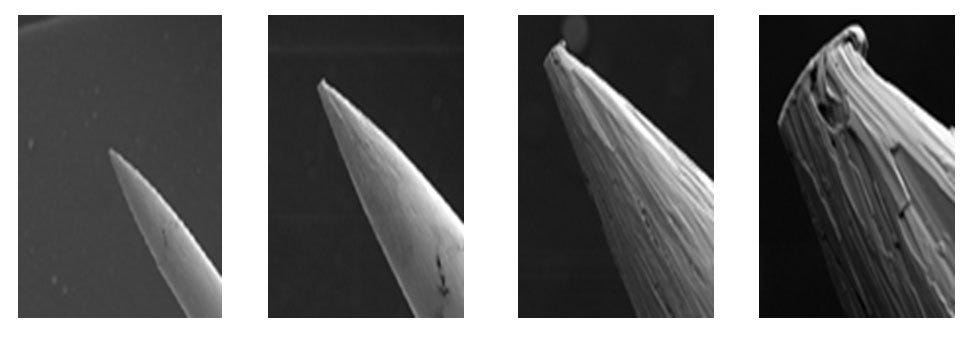
A dull needle causes flagging because it doesn’t pierce the fabric cleanly. Instead, it pushes the fabric down into the needle plate hole before punching through.
This is a rare case where what goes down comes back up. Fabric pushed down into the needle plate hole will naturally spring back toward the plate surface — at the same moment the needle is rising. Fabric and needle move together, the distance between the eye and the fabric doesn’t change, and there’s no loop for the hook to catch.
That’s flagging — and the result is skipped stitches.
Bent Needle = Poor Needle-Hook Clearance
Why a few thousandths of an inch matter
A sewing machine is essentially a knot-tying robot. Its job is to tie a knot between the needle thread and bobbin thread, cinch that knot firmly into the fabric, then repeat — over and over again.
The hook passing behind the needle, below the needle plate.
The most important moment happens below the needle plate, when the hook passes behind the needle. That’s where the hook catches the needle thread and carries it around to form a loose knot with the bobbin thread.
A skipped stitch happens when the hook fails to catch the needle thread. One cause is a machine that’s out of time (I’ve written about sewing machine timing before). But a more common cause is that the machine’s needle-hook clearance is off.
What is needle-hook clearance?
When the hook passes behind the needle, it must pass a very specific distance away from it. The way my dad taught me: the hook should be so close to the needle that you can barely see daylight between them. Gently tap the needle with your finger to flex it ever so slightly, and it should touch the hook.
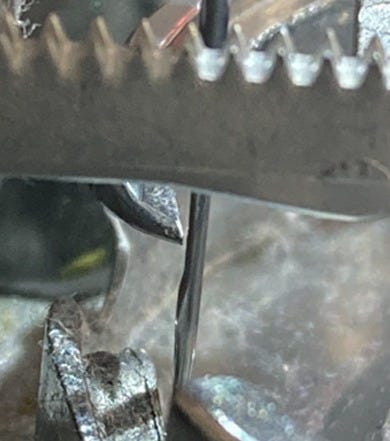
There isn’t much room for error:
- Too much clearance
- The hook passes too far from the needle and misses the thread.
- Too little clearance
- The hook deflects off the needle, making it very hard to catch the thread.
Needle-hook clearance is a critical setting a trained technician checks during every service. It can be tightened if it’s excessive, or opened up to create daylight if it’s too tight.
So why bring it up?
Because bent needles mimic poor needle-hook clearance.
Your machine’s clearance can be set perfectly to factory specs and you’ll still get the symptoms of poor clearance if the needle is bent — even slightly.
- Bent forward
(toward you) - Mimics excessive needle-hook clearance.
- Bent backward
(away from you) - Mimics tight needle-hook clearance.
Either way, skipped stitches may follow. So whenever you’re troubleshooting skipped stitches — or any other stitch quality problem — step one is always the same: put in a new needle.
Step one, sorted
Keep fresh needles on hand
Not sure which needle you need? Our needle guide explains types and sizes. If in doubt, an 80/12 Universal is a safe place to start.
Shop all needlesThank you for reading
This post originally appeared in The Sewing Machine Newsletter, where you’ll find over a hundred more essays on how sewing machines work and how to keep them running.
—Cale
