
What does it mean for a sewing machine to be “out of time”?
Technician Tips · Timing
What does it mean for a sewing machine to be “out of time”?
It’s worth understanding, because if your machine is out of time, you’ll likely need a trained technician to fix it. If it isn’t, the problem lies elsewhere, and the fix may be in your hands.
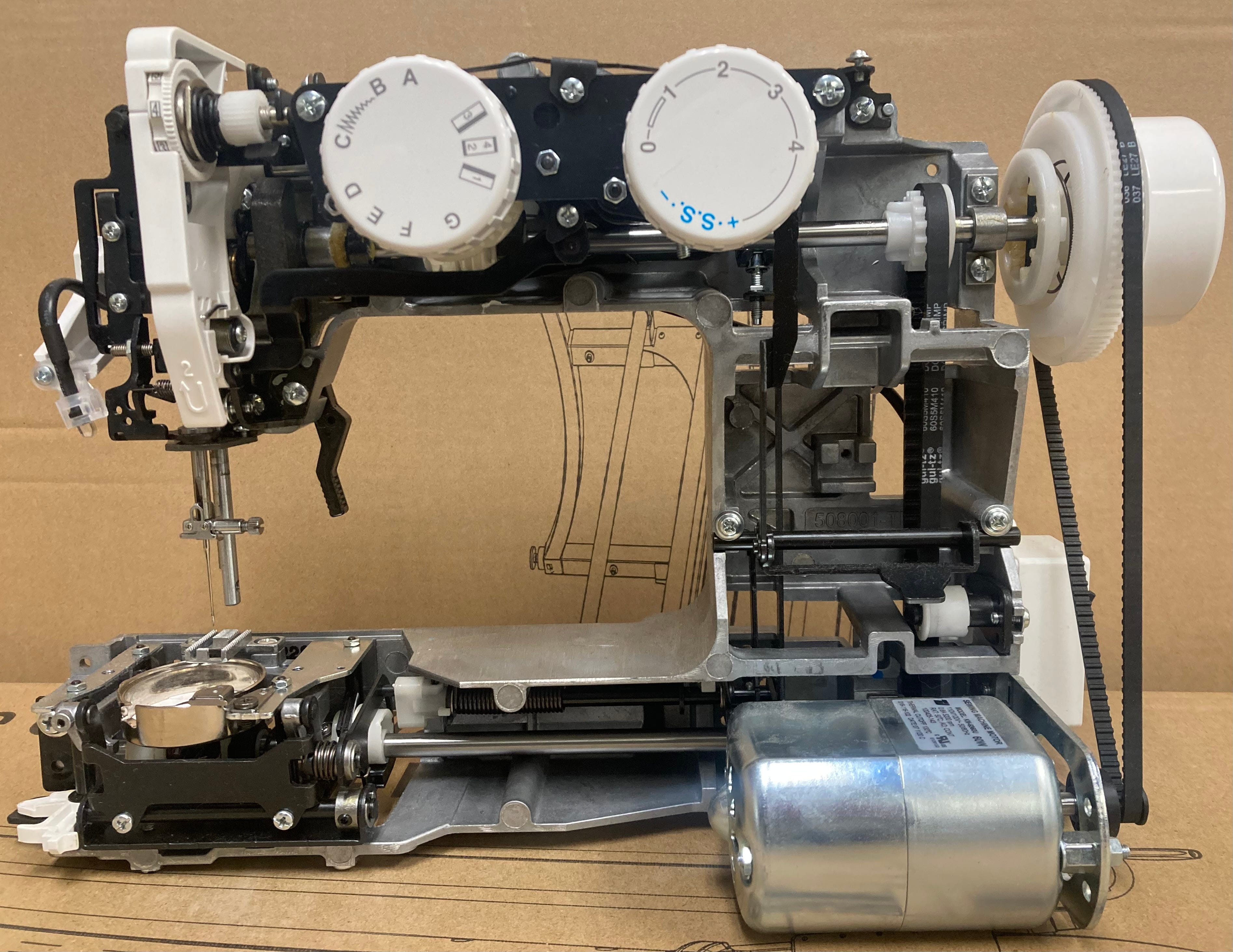
When we talk about timing, we mean the timing between the machine’s upper shaft and lower shaft. The two must operate in harmony, because each controls components critical to making a stitch.
- Upper shaft
- Controls the movement of the needle bar, and therefore the needle.
- Lower shaft
- Controls the movement of the hook and the feed dogs.


The upper shaft drives the needle; the lower shaft drives the hook and feed dogs.
Because the needle bar has to stay in sync with both the hook and the feed dogs, there are two types of timing:
- Needle-hook timing: the precise timing between the movement of the needle and the hook.
- Needle-feed timing: the precise timing between the movement of the needle and the feed dogs.
Needle-Hook Timing
Where the hook meets the needle
A useful way to think about needle-hook timing is to look at how the needle and hook move on their own, and then how they relate during the stitch-making process.
The hook
- The hook rotates around the bobbin and bobbin case, whether your machine has a rotary hook or an oscillating hook.
- On oscillating hook machines, the hook point rotates back and forth on a vertical axis, clockwise and then counter-clockwise.
- On rotary hook machines, the hook point rotates continuously counter-clockwise, on a horizontal or vertical axis.
The needle
- The needle starts in its highest position, several centimeters above the needle plate.
- It travels down below the needle plate until it reaches its lowest position.
- Then it travels back up above the needle plate to its highest position again.
The needle (upper shaft) and hook (lower shaft) moving together.
The needle’s revolution and the hook’s revolution are timed so the hook passes behind the needle at a very specific moment: when the needle has risen 2–3 mm above its lowest position, the hook point should pass just above the needle eye.
Why? Because as the needle rises, a tiny thread loop forms at the eye of the needle, on its back side. If the machine is correctly timed, the hook point passes just above the eye and through that loop right after it forms. The hook catches the loop and takes the needle thread along for the ride around the bobbin case, forming a knot between the needle thread and bobbin thread.
What does it look like when needle-hook timing is off?
Remove your needle plate and bobbin case. Turn the hand wheel toward you until the needle reaches its lowest position, then keep turning slowly so you can see the needle start to rise. As it does, the hook will pass behind the needle. Where on the needle is the hook passing?
Checking where the hook point passes the needle.
We want the hook to pass just above the eye of the needle after the needle has risen 2–3 mm. Timing can be off in either direction:


Needle-Feed Timing
Feed only when the needle is out
Like hook timing, feed timing is easiest to understand as a relationship, this time between the needle and the feed dogs.
The feed dogs
- The feed dogs start above the needle plate, with their teeth gripping the bottom layer of fabric.
- As the needle enters the fabric, the feed dogs drop beneath the needle plate and stop touching the fabric.
- As the needle rises back above the needle plate, the feed dogs rise too, making contact with the fabric again.
- Once above the plate, the feed dogs move from front to back by your stitch length (typically 2–4 mm).

The needle and feed dogs are timed so the feed dogs drop beneath the plate while the needle is in the fabric, and only rise and feed after the needle has risen out of it. In other words, the feed dogs only feed the fabric after the machine has made a stitch.
Watch the feed dogs drop while the needle is down.
What does it look like when needle-feed timing is off?
Proper needle-feed timing looks like this:
- As the needle enters the needle plate hole, the feed dogs should be going down beneath the needle plate, no longer feeding the fabric.
- As the needle rises out of the needle plate, the feed dogs should begin to rise out of it too.
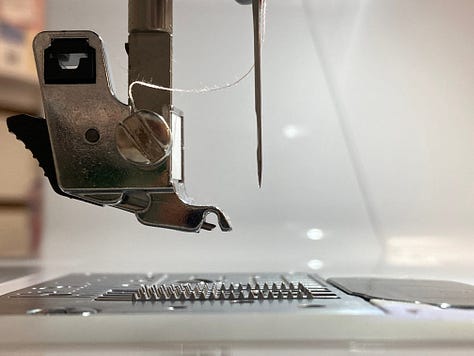

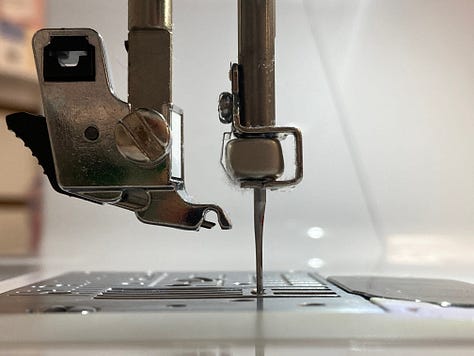
Needle up, feed dogs up. Needle down, feed dogs down.
If the needle is below the needle plate while the feed dogs are above it feeding the fabric forward, feed timing is off. If the needle is above the plate but the feed dogs don’t rise until the needle is about to re-enter the fabric, feed timing may also be out of whack.
We don’t want fabric fed while the needle is in it for a few reasons. If the needle is deep in the fabric while it’s being fed, the needle will bend or break, potentially causing harmful needle strikes on the hook, needle plate, and bobbin case. And even if feed timing is only slightly off, stitch quality suffers, because the feeding action helps cinch the knot properly into the fabric.
What Causes a Sewing Machine to Go Out of Time?
The usual suspect
I’d guess the most common reason is trying to sew through something too thick for the machine to handle.
Imagine sewing thick leather on a small home sewing machine. The needle (upper shaft) gets stuck in the material and stops, but the hook and feed dogs (lower shaft) keep turning. Any mismatch between the upper and lower shafts, even for a split second, can knock the machine out of time.
Can You Fix a Timing Issue Yourself?
Short answer: probably not
To fix a machine that’s out of time, you have to remove the machine’s covers to expose the internal components, disengage the lower shaft from the upper shaft, and manually time the hook and feed mechanisms to the needle position. The sequence matters, and the timing must be very precise. Sewing machine companies even make model-specific tools and gauges to help technicians get it right.
That’s all to say: if your machine is out of time, take it to a trained sewing machine technician.
What a full service coversThe Sewing Machine Technician’s Checklist
Think your machine is out of time?
Let our technicians re-time it
Our service department in Walnut Creek times and adjusts machines every day, to factory spec, with the right gauges for the job.
Thank you for reading
If you found this article helpful, feel free to share it with fellow sewing machine enthusiasts.
— Cale
More troubleshooting
