
Sewing Adhesive: Technician Tips
The Problem of Sewing Adhesive
How sewing adhesive & other sticky substances can interfere with loop creation & cause poor stitch quality
There are inherent problems of sewing adhesive, for it can hurt your sewing machine and negatively affect stitch quality.
If the fabric we’re sewing is coated in excessive adhesive, then there is a strong possibility the adhesive will adhere to the needle shaft when your needle pierces the fabric. This interferes with proper loop creation, which in turn interferes with proper stitch formation.
Remember, the thread loop forms above the needle eye, and the sewing hook passes through the thread loop. If the needle shaft is sticky, the thread could get stuck on the shaft, which could distort the shape of the thread loop, or prevent the loop from forming altogether. Thus, the likelihood of skipped stitches skyrockets, since skipped stitches occur when the hook does not successfully pass through the thread loop.
From the perspective of a sewing machine technician, excessive adhesive often leads to skipped stitches. However, this does not mean you can never use adhesive at all. You can use adhesive, but I highly recommend you use the least amount of adhesive as possible when using adhesive for a project.
Miscellaneous Notes on Adhesive & Sewing:
- Two adhesive brands I like [in 2025] are 505 Temporary Adhesive & Spray-n-Bond Basting Adhesive; both do a good job in terms of not gumming up the needle.
- Velcro contains adhesive. If you do sew Velcro, there is a good chance the needle gets sticky, so be aware that you may have to change your needle more than usual in order to finish a Velcro project.
- If you’ve been using adhesive and experience skipped stitches, try changing the needle. Sometimes a fresh needle that isn’t coated in adhesive will solve the problem.
- If way way wayyyyyy too much adhesive is used, it is possible for the adhesive to coat the bobbin case and/or sewing hook. This is not good. Stitch quality will suffer and changing out the needle will not solve the problem. You will likely need to take the machine to a technician who can access the entire hook area in order to clean it properly.
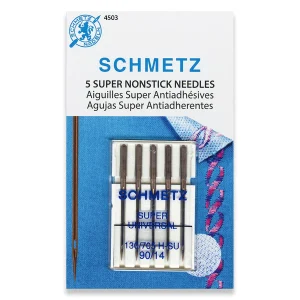
- Needle manufacturers like Schmetz make a “Super NonStick” sewing machine needle that is essentially a Universal needle with anti-adhesive coating (NIT) that resists sticky stabilizers, fusibles, and adhesives. Although they aren’t guaranteed to be 100% effective, these nonstick needles are better than generic needles when sewing with adhesive.
Miscellaneous Notes on Adhesive & Sewing:
- Two adhesive brands I like [in 2025] are 505 Temporary Adhesive & Spray-n-Bond Basting Adhesive; both do a good job in terms of not gumming up the needle.
- Velcro contains adhesive. If you do sew Velcro, there is a good chance the needle gets sticky, so be aware that you may have to change your needle more than usual in order to finish a Velcro project.
- If you’ve been using adhesive and experience skipped stitches, try changing the needle. Sometimes a fresh needle that isn’t coated in adhesive will solve the problem.
- If way way wayyyyyy too much adhesive is used, it is possible for the adhesive to coat the bobbin case and/or sewing hook. This is not good. Stitch quality will suffer and changing out the needle will not solve the problem. You will likely need to take the machine to a technician who can access the entire hook area in order to clean it properly.
- Needle manufacturers like Schmetz make a “Super NonStick” sewing machine needle that is essentially a Universal needle with anti-adhesive coating (NIT) that resists sticky stabilizers, fusibles, and adhesives. Although they aren’t guaranteed to be 100% effective, these nonstick needles are better than generic needles when sewing with adhesive.

Summary
- Adhesive interferes with proper loop creation, which in turn interferes with proper stitch formation, often causing skipped stitches.
- If you’ve been using adhesive and experience skipped stitches, try changing the needle. Sometimes a fresh needle that isn’t coated in adhesive will solve the problem.
- If way too much adhesive is used, it is possible for the adhesive to coat the bobbin case and/or sewing hook. This may require a trained technician who can take the machine apart and clean the infected areas properly.